Friday, June 12, 2015

Intentional & Unitnetional

After the time of the civil war, Buffalo Soldiers and Native Americans were discriminated against by the white settlers and the government. Buffalo soldiers were African American soldiers also known as the United States Colored Troops. These soldiers were needed by the federal government during the Indian Removal Act. This act was enacted  by president Andrew Jackson and was meant to move native American Tribes who were settled in southern areas more to the west so that the whites could colonize these areas, and expand the nation. Many of the Native American believed that this act was unfair, and they tried to act against it. the circumstances in which the native American were forced into were terrible and many of them lost their lives along their awful journey west. While the native american did try to stop this from happening, the Indian Removal Act was successful because of the Buffalo Soldiers, however, the conditions in which the Buffalo soldiers were put under were also terrible and they were very discriminated against. Our essential question for this topic was, Was the discrimination that the Buffalo soldiers and Native Americans faced intentional or did the White settlers and federal government actually believe that what they were doing was just? To find the information we used to create this question and learn more about the discrimination against these two groups we took notes together as a class on PBS and ABC-Clio videos about the buffalo Soldiers and the Native Americans, and we also read excerpts of primary source documents including Helen Hunt Jackson's Century of Dishonor, and The Dawes Act 1887.  
while the discrimination can be viewed as either intentional or unintentional, I believe that the discrimination against these Buffalo Soldiers and Native American was both intentional and unintentional in different circumstances. One case in which the discrimination against the Native Americans was unintentional was because the white settlers viewed them as people who needed their help in order to survive, and they believed that what they were doing was just simply to help them. we see this in Helen Hunt jackson’s book, A Century of Dishonor when she states, “subsist by hunting, fishing, on roots, nuts, berries, etc., and by begging and stealing”. here she is saying that the Native American who were not receiving help from the government had to beg and steal to stay alive. Because they saw them as helpless they thought they were doing an act of justice by helping them. On the other hand, in some cases the discrimination was intentional. the federal government and white soldiers wanted to have complete control over the land in which the Indians once had control over. In the Dawes Act it states, “ ...any reservation or any part thereof of such Indians is advantageous for agricultural and grazing purposes, to cause said reservation, or any part thereof, to be surveyed, or resurveyed if necessary, and to allot the lands in said reservation in severalty to any Indian located thereon in quantities…”. this quote tells us the the government gave themselves the power to slip up native American's land and distribute it in a way so that they had complete control over how much land they could own. This is an example of intentional discrimination because here the government wasn't helping them because they were helpless, they were helping them so they could take advantage of the land that they owned.while the white settlers believed that they were “Friends of the Native Americans”, some actions they took were still unjust.   
As well as the discrimination against the Native Americans, there was also both intentional and unintentional discrimination of the Buffalo Soldiers. In one case the government may have believed that what they were doing was just by providing them a job other than sharecropping, which was much like slavery, and giving them clothing, food, and shelter. However, they also discriminated intentionally against these Buffalo soldiers because they were being used to do work that no one else wanted to do. Some of the jobs that they had as Buffalo Soldiers included, fight against the native Americans, difficult labor such as laying down electrical line and clearing the paths for the Native Americans, as well as risking their lives in the most dangerous battles. Because of the horrible conditions of their jobs, in this case the discrimination was intentional. even though they provided the soldiers with many resources believing that they were helping them, they also intentionally discriminated against them in some way.  Both the Buffalo soldiers and the Native Americans were treated with discrimination, that was intentional and unintentional, from the White settlers and the federal Government.

Friday, June 5, 2015

Captains of Industry

After the time of the civil war and during the reconstruction, John D Rockefeller and Andrew Carnegie were two very important people to the American economy. As businessmen during this time it was very debatable whether these men were robber barons or captains of industry, and many had different opinions on the matter. A robber baron during this time period was considered to be someone who was an American capitalist who acquired a fortune in business by ruthless means, and who were corrupt businessmen competing to be the at the top in their business. On the other hand, a captain of industry was considered to be a business leader, who while making a  personal fortune, contributed greatly to the country and its economy in ways such as increasing productivity, expanding markets and providing jobs. For this unit we created our own essential question which was, were Carnegie and Rockefeller robber barons or captains of industry? To learn more about this topic and gather information to not only construct our essential question,but also answer it, we first watched a series of videos and as a class collaborated by taking notes on different topics in a Google Doc. We then read background summaries on Carnegie and Rockefeller, as well as looked at some primary sources and once again took notes.
Carnage and Rockefeller were captains of industry. Even though both men were not liked by everyone, because of their competitiveness with other companies, and their occasional use of illegal tactics and immoral business techniques, both men did give back greatly to our country and its economy. Rockefeller believed that it was his duty to give a portion of his earnings back to the community. In an interview he once stated, “”...I believe it is my duty to make money and still more money and to use the money I make for the good of my fellow man according to the dictates of my conscience.” Rockefeller is saying that the money he was making was in the benefit of others because those profits allowed him to give back to the community, however he knew that it is his business to try to make the most money, and be the top business. one example of a way in which he gave back to the community, other than providing oil and jobs through his company, was that he once donated $500 million to schools, science and medicine. this proves that while Rockefeller was trying to make the most money, he was putting all of his profits to good use, and they were benefiting others than himself.  Like Rockefeller, Carnegie had similar motives during business career. in his essay, wealth, Carnegie states, “...[it is the] matter of duty to administer in the manner which, in his judgment, is best calculated to produce the most beneficial results for the community /the man”. Carnegie is saying that he believes it necessary for him to consider all surplus revenues as a way to give back to those who have helped him. Also, Carnegie used his excess wealth to provide for the wants of those who depended on him.
Both Carnegie and Rockefeller are captains of industry because they did many things to give back to others. Today many companies do the same thing, by giving back to society in many different ways. For example TOMS donates shoes to those in need, the sun glasses company, Panda, gives a free eye exam and prescription glasses for school-aged children, and even bigger companies such as Walmart donate millions of dollars worth of food each year to those in need. Overall, while both Carnegie and Rockefeller thought it was crucial to try and strive for being on the top , in order to be successful in the business world, they found it even more important that they use their success in way that would be beneficial to others and the community, just like many other companies do today.  


Thursday, May 7, 2015

A Voice for Equality

Slavery was one of the biggest issues during the civil war, and while  it appeared as though people of the upper class were granting slaves their freedom, however the slaves may have fought themselves for their own freedom. to learn more about freedom being granted from either above or below, meaning that either people of upper rank freed those below them or those below on the social pyramid helped to free themselves.First, we defined freedom from above and freedom from below by looking at a social pyramid, then we analyzed several documents that including evidence about the goal of the war, Abraham Lincoln’s position on freeing slaves, as well as his personal opinions on war. These documents included, An Open Letter to Horace Greeley, The Emancipation Proclamation, The Gettysburg Address, and The Second Inaugural Address. We also watched videos to help expand our knowledge on these documents and the subjects in which they covered. Lastly, using the notes we took on each of the documents, and our knowledge from our class discussion on them we compiled a list of which documents proved freedom from above and which proved freedom from below.  All of these activities helped us to answer our essential questions for this unit which were, Who ‘gave’ freedom to enslaved Americans? Did freedom come from above or below? and, to what extent were Lincoln’s actions influenced by the actions of enslaved Americans?

Abraham Lincoln had great influence on slavery, and if it weren't for him and the actions, slavery wouldn't have been able to be abolished. Lincoln declared the Emancipation Proclamation as well as the 13th amendment to help put an end to slavery. Lincoln fought to free the slaves, and in the Open Letter to Horace Greeley he stated that slavery had become the main cause of the war. Abraham Lincoln Fighting to free the slaves can be seen as freedom from above, for he was highest on the social pyramid, and therefore the freedom was coming from above the slaves. However, Lincoln wouldn't have done this if it weren't for the slaves standing up for themselves and making it know that they wanted freedom because they deserved it just as much as anyone else. In one of the documents we examined, document x, slaves had left their plantation and gone to Chickasaw Bayou. this shows that the slaves themselves were taking action, and therefore that the freedom was coming from below because the slaves, who were at the bottom of the social pyramid, where fighting for their own freedom. I think that freedom came equally from above as it did from below because the enslaved people initiated the action by standing up and showing what they believed in by fighting for themselves, but these thoughts and feeling couldn't ever had been reinforced if it weren't for Lincoln's power, and the actions that he took to abolish slavery.

Today, there are also many issues throughout society that are fought by people below and made more well-known by people above. One recent example of this would be Bruce Jenner who recently came out as being a transgender. While transgenders have been fighting to become recognized as equals,someone like Bruce Jenner who is well known has made it more possible for this to become a reality, and he has become a voice and an icon for transgenders everywhere, just like how Abraham Lincoln used his superiority,and popularity to make it known what the slaves were fighting for and ultimately becoming a voice for the slaves and their equality.


Friday, April 10, 2015

Civil War Scavenger Hunt

During the civil war there were many important battles fought all which took place in one or more of the three theaters, eastern, western, and naval. To learn about each of them we did a scavenger hunt in class. Each person was assigned one of the battles, in which we then made a Google doc for including information such as where and when the battle took place as well as the victor, theater and two other facts that explained why the victor won. We then made a QR code for that Google doc that we placed somewhere in the school. Each Google doc had information as to where the proceeding one was located so that we could easily find all the information. Using the information we collected from the scavenger hunt we then made a Padlet where the class collaborated to decide where the theater for each battle was located and why, and used this information to answer our essential questions.

Each of the three theaters was dominated by a different victor.  In the east the  overall victor was the confederacy, because they used their surprise attack tactics to win battle such as the battles of Bull run and the battle of Chancellorsville. The union was the overall victor for the western theater. because the union had an advantage in their numbers of soldiers, they were able to win battles such as the battles of fort Henry, fort Donelson, and the battle of Shiloh. Lastly, the union was also the victor for the naval theater. With a well trained and stronger army and once again their greater number, Ulysses S. grant had some great tactics that helped the union to dominate the battles that took place in the naval theater.

After completing the scavenger hunt and the padlet it was more clear why each side won in the different theaters. Overall, the union was the main victor of the war because they had a better military with more soldiers, good strategies, and resources, which helped them to be successful in defeating the confederacy in most of the battles. The confederacy had won the battles they did because of their defensive strategies. I really enjoyed this lesson because doing the scavenger hunt was a fun and effective way to learn the information about all the battles

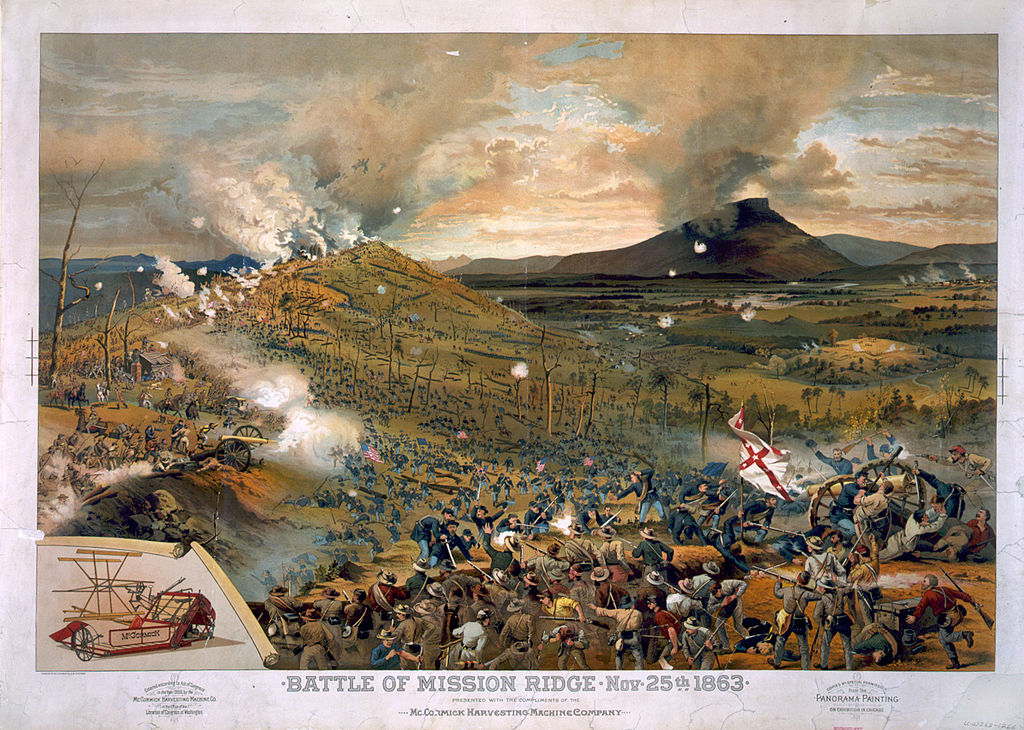
1024px-Battle_of_Missionary_Ridge_McCormick_Harvesting.jpg

Battle of Mission [i.e., Missionary] Ridge, Nov. 25th, 1863, Cosack & Co. lithograph from McCormick Harvesting Co., c1886.http://en.wikipedia.org/wiki/Battle_of_Missionary_Ridge


.


Thursday, March 19, 2015

Division From Slavery


For this lesson we covered the topic if the election of 1860, and hoe it was affected by slavery and the divisions in which it caused. Our essential question was, how were the results of the election of 1860 representative of the deep division over slavery? Before the civil war the country was divided by views on slavery, which by looking at the map of the results of the election of 1860 it is clear that the north and west supported Lincoln who was anti-slavery, and the south supported Breckenridge who was pro-slavery. The middle region of the country supported Douglas and bell. Douglas supported popular sovereignty and bell believed in keeping everything the same. The clear separation between the northern and southern states indicate that the election of 1860 was representative of the deep division over slavery.

In class we used Educreations to make a video about the events that took place leading up the the election. Before we could create this project we first watched a crash course video by John Green on the topic, and then did research on a website called, Civil War in Art where we analyzed artwork and took notes on how it connected to the event in which it represented. Lastly we compiled the information we gathered along with the artwork to create a short documentary.


Thursday, March 12, 2015

North VS. South


During the civil war and the division between the northern anti-slavery states, and the southern pro-slavery states, each side had their advantages that the other lacked. I used an info graphic to show these advantages and disadvantages of the offending north and the defending south by compiling statistics into charts and graphs and analyzing war strategies. Some information that i chose to include in my info graphic includes, the population of both the north and south as well as the slave population, the number of industrial workers, railroad mileage, and the amount of manufactured goods. i finished off my info graphic by  explaining the strategies of both the north and the south. The process of creating this info graphic helped my to look at the statistics of the north and the south, allowing me to realize how it applied to the advantages of each side and why it is significant.   

Thursday, March 5, 2015

Ignoring Slavery

In the early 19th century was a huge debate in american society. There were two groups of people that this debate split our country into, the pro-slavery side which was generally located in the south, and the anti-slavery side, which was generally located in the north. Our essential question for this lesson was, How did we know the debate over slavery was the “elephant in the room” for american politics in the early 19th century? To learn more about these debates and answer our essential question we  looked at many of the events that took place during this time period and compiled
the information into a timeline. The events that 
we learned about on our timeline help to prove
that slavery was “an elephant in the room” 
because while it was a big debate whether 
or not states should be free or slave states , 
the idea of slavery itself was somewhat ignored.


The first event that proves slavery to be “an elephant in the room” during the early 19th century is the Compromise of 1850.  prior to this event there had been 11 slave states, and 11 free states for 30 years because of the Missouri compromise. however, in 1850, California requested to join the nation as a free state, which inevitably would throw off the balance of free and slave states. to solve this issue Henry Clay proposed the 5 part compromise. this compromise let California be organized as a free state, but also organized New Mexico, Nevada, Arizona, and Nevada without the mention of slavery. Also because of this compromise the slave-trade in DC was shut down, and the fugitive-slave act was passed in order to satisfy the imbalance of adding another free state. Another event that proved slavery to be “ an elephant in the room” was the Gadsden purchase. The US paid $10 million for a strip of land known as the Gadsden purchase, which would be used to build the transcontinental railroad. By doing this more pro slavery settlers would come and settle there, which would later affect the vote of whether or not the land would be free or pro slavery. Both these acts, the Compromise of 1850, and the Gadsden purchase focused on the idea of  determining whether or not states would be free or slave states. Because of this no one actually discussed and debated about what should be done about slavery, making it the elephant in the room.  


A third event that proves slavery to be “an elephant in the room” is Bleeding Kansas. In 1856 Kansas was a new territory filing for statehood, and because both pro-slavery and anti-slavery advocates wanted the land to support their side, two capitals were set up, one a free capital and another a slave capital. This resulted in violent battles being fought over which side would get to have the land. Lastly, The caning of Charles Sumner is an event that took place that help to prove that slavery was “an elephant in the room”. Charles Sumner a senator during this time, spoke a two day speech about his views on slavery in Kansas titled, Crime Against Kansas. In his speech he stated, “Such is the Crime and such the criminal which it is my duty to expose; and, by the blessing of God, this duty shall be done completely to the end.” Because his speech was directly targeting those who were pro-slavery specifically Andrew Butler, his nephew, Preston Brooks, beat Sumner with a cane.  These two events help us to see that slavery was indeed, “an elephant in the room” because slavery was a somewhat ignored topic,that was never resolved which eventually lead to violence because no one knew any other way to solve the issue.

Tuesday, February 24, 2015

Human Dignity

In the 18th and 19th centuries Slavery was a huge part of american Society. Both sides that were against and for slavery had strong arguments supporting their position on the topic. Much controversy and many arguments were caused because of slavery because while some didn't see it, it took away a slave's freedom, but also their dignity, and individuality. While slavery clearly wasn't moral it was a huge part of the American economy, and was responsible for 2.28 billion pounds of cotton, 57% of the nations export revenue by 1860. Because of this slavery quickly became entrenched in America. While covering this topic in class we looked at articles of the constitution, and maps of the growth of slavery in america, as well as researching important figures of this time period and watching a movie about the life of a slave, to help us answer our essential questions for this lesson.

Slavery was constantly increasing and become more and more necessary to the Country's economy during the 19th century. By looking at maps of this increase of both slave population and cotton production on a website called Mapping history, it is clear that the number of slaves in america directly correlated with the amount of cotton being produced. While cotton was insignificant in 1790 and only 1.5 million pounds were produced, and the slave population was only around 690,000, the amount of cotton produced increased greatly to an astonishing 2.28 billion with a slave population of 3.95 million. A main reason for this increase was because of Eli Whitney's invention of the Cotton Gin, a machine that separated the seeds from the raw cotton, and made the cotton production process significantly quicker. This invention caused the price and number of slaves to increase. While it is clear that slavery was a huge part of the country's economy it was also part of the American Government. Many parts of the constitution regarded slaves and their rights. In Article 4, Section 2, Clause 3  of the Constitution it states,  "No person held to service in on estate, under the laws thereof, escaping into another, shall, in consequence of any law or regulation therein, be discharged from such service or labour, but shall be delivered up on claim of the party whom such service or labour may be due." this article is saying that if a slave escapes from a slave state to a state that prohibits slavery, they are not free of their owner, but they must return to them.

Not only did this slavery based system effect both the Economy and the government, but also human dignity, and it ignores human characteristics such as individualism, pride, and freedom. The system of slavery destroyed human dignity and many other  human characteristics by treated the slaves as though they were property and not people. While some noticed that this was wrong and did what they could to stop slavery, some people, like George Fitzhugh believed that slavery was necessary for society. Fitzhugh states in his book Canniblas All, "The negro slaves of the south are the happiest, and, in some sense, the freest people in the world. The children and the aged infirm work not at all, and yet have all the comforts and necessities of life provided for them." What Fitzhugh is saying proves how slavery ruins human dignity because the slaves aren't allowed to live on their own and they have everything handed to them as though they wouldn't be capable of doing it themselves. As well as loosing their dignity slaves also lost their humans characteristics, because by entry this system of slavery one completely lost their individuality, and were no longer treated like humans. one specific example of this is in the movie, prince among Slaves, which we watched in class, when prince Abdul Rhaman was captured into slavery and had it long hair cut short, so that he would be like all the other slaves, destroying his symbol of his high rank in his country, and therefor ruining his pride, and individual identity. Slavery completely took away a person dignity because they were forced into a system  that they had no individual identity.  


Monday, February 2, 2015

Equality for All

Recently in class we finished a unit on the Woman’s reform and how in the mid-19th century this movement was started in an attempt to gain equality for women.  our essential questions for this lesson were, How did mid­-19th century  American society react to women's demands for  equality? Does 21st century society still react  differently to men and women?we started our lesson by looking at an image called the sphere or women, and analyzed it highlighting all the jobs of a women were represented in the picture.  We  read, The intimately oppressed to get a better understanding of the rights that women had during the time period. We also read, Laws and practices to get a better understanding of the rights that women had during the time period. Lastly we looked at articles for the Seneca Falls Convention to learn about what action that women took during the movement.  During the woman's reform women were treated differently than men and there were many different views upon equality for women, and their roles in society.


illustration from Godey's  Lady's Book, March  1850 Found at: http:// www.assumption.edu/ whw/workshop/ untitled1.html http://www.edline.net/files/_AIGmX_/90f5674f15c6c9f63745a49013852ec4/Activity_8_-_Lesson_Notes.pdf  acsessed, Febuary 2,
2015


In the mid-19th century women were treated very differently than men. It was believed that it was a woman's job to stay home and take care of the house and family. A women had the responsibilities of taking are of children as well as teaching them, especially daughters for they didn't go to school like young boys did. Along with taking care of any kids a woman also had to take of any pets. She was in charge of making clothes for the family, as well as fixing them. However, if a woman wanted to get a job outside of the house the only one that was available was a teacher, and often times she would get paid significantly less than a man doing the same job. There were many different views and opinions about women's equality, and while some supported woman's equality others believed that women should stick to their specific gender roles. the Oneida Whig states, “If our ladies will insist on voting and legislating, where gentlemen, will be our dinners and elbows?” This quote proves that many were against the woman's reform because they strongly believed that all women should stay home so that they can cook and clean and take care of the family. While some feared what would happen if women didn't stay with their gender specific role, and strongly didn't support the reform, others who did support the expansion of woman's rights. in The National Reformer it states, “They may ridicule, but not reason away the facts and arguments there set forth.” This quote shows that the people who supported woman's rights believed that all women deserve to be treated equally, and that men can ridicule them, and they can believe that don't deserve to be treated equally, but they don't have any good reasons against why women should be equal.

While women role in society today has changed greatly from what it was in the mid-19th century, 21st century society still views women and men very differently. in the Pantene commercial, "Labels Against Women" the different views of men and women are portrayed. while i don't agree with all of the circumstance in the video, i do believe that some of them are common in society today. I agree that a woman working a full time job with a young child and a man doing the same is viewed differently. the women is thought of as selfish because she has a child to take care of and she is staying up late to finish her work, leaving her with less energy to take care of the child, whereas the man is viewed as dedicated because he has a child to take care of and he is still spending time that he could be resting trying to do his job to earn money for the family. one of the circumstances that i don't agree is prevalent in society today is the man and women politician who are viewed as persuasive versus pushy. this commercial does a good job of showing how differently men and women are perceived and how people label them. Although we have come along way on the road to equality for men and women from the mid-19th century men and women are still treated differently in today's society.
 

Monday, January 12, 2015

A Natural Right

The Gilder Lehrman Institute of American History. "Religion and Social Reform".  The Gilder Lehrman Institute of American History. https://www.gilderlehrman.org/history-by-era/first-age-reform/resources/religion-and-social-reform-social- reform. (accessed January 2015).


Horace Mann is writing about public education and he believes that everyone has the right to an education so it should be provided for them. His purpose in producing this document is that he is trying to persuade people that public education is necessary and should be available to anyone. This is a very believable and trustworthy source. It was written in the 19th century, which is the time period in which the education reform took place. It was written by Horace Mann Who was the first person to be elected as the board member of education, and it was accessed from a History data base.

When this document was written the education reform was taking place. The idea of public schools and that everyone could get an education for free was still developing during this time. Horace Mann wanted to make sure that everyone was given the opportunity to get a proper education, and he went town to town observing schools. The schools he was were poorly built, and they had a lack of teachers and supplies. This document tells us that Horace Mann was a very important person during the education reform because he strived to make sure that public education was available, and he wanted to fix all the problems that currently existed within public schools. He super headed the common school movement, ensuring that every child received a basic education that was funded from taxes. He brought better books and supplies into schools to better the students educations as well. While this document does do a good job showing that public schools weren't really available to everyone and that is was Horace Mann was trying to fix, it doesn't show the problems within the schools that existed. It also doesn't tell us anything about how the problem of education was fixed.

  
In this document Horace Mann claims that everyone has the right to an education, and he says that it is important that they do so because it will effect their future and better their society. He uses the reasoning  that Massachusetts always solves their problems instead of trying to prevent them, and that if they provide public education the knowledge the children gain from their education can help solve problems. He believes that if everyone got an education it would encourage them to be good, and to do good for their society. He uses words such as great, immortal, and describes education as a natural right to prove that education truly is important not only to the children themselves but for the greater good of society, and therefor it is a necessity.


Thursday, December 11, 2014


Recently in class we learned about 7th president of the United States, Andrew Jackson, who was the first to be elected through the democratic process. the three main parts of his presidency that we focused on were the Indian removal, Spoils system, and Bank War. After splitting into groups and analyzing documents and watching videos about one of the three specific topics, each group created a short video project to answer our essential question, Is Andrew Jackson long-standing reputation as “the people’s president” deserved? my group was assigned the Bank War, and we created our video on goanimate.com, using speaking avatars to discuss the topic.  


Andrew Jackson Project by ma.staffier on GoAnimate
The bank war was Jackson effort to destroy the second national bank because he believed that it was gaining too much power all in the hands of few people and that the bank was a threat to their independence and liberty. The rich and powerful were bending the rules for their own benefit which is a threat to the whole system, and Jackson believed that the bank was giving the wealthy people and unfair advantage. The bank had the power to control peoples lives and the political system and because of this Jackson wanted to get rid of it, however people thought that Jackson’s plan to blow up the bank was insane. By getting rid of the Bank Jackson believed he was looking out for the middle and lower classes, and at the same time doing the opposite for the upper class. He didn't really deserve his title based on the bank war because he wasn't doing good for everyone just a group of people.  


The Indian removal was a plan created by Jackson where he had to the goal of moving the native Americans off of their land, and push them to the west so that he could expand leaving more room for white settlers. The Indians didn't want to move because they feared what would happen if they did. A law was passed in congress that made it possible for them to subject the Indians with their own laws. While forcing natives off their homeland may sound very harsh Jackson claimed that by him relocating the Indians that he was actually helping them and that if he set land aside for them it would forever be theirs and they would be safe from the white setters. the Indian removal act resulted with a total loss of 10,000 Cherokee Indians. From the point of view of the white settlers in the situation of the Indian removal Jackson deserved his title because he is doing good in their favor, however from point of view of the Indians he didn't because he pushed them off of land that was rightfully theirs and caused many deaths.  

Lastly, The Spoils System was a system developed by Jackson where after a political party won an election all of the supporters would be given jobs in order to keep them supporting that party. because of this system Jackson ended up firing 919 officials, and gave a job that was a government position to a criminal because he was a supporter , and 1.2 million dollars ended up being stolen from the government. Because of The Spoils System Andrew Jackson doesn't deserve his title because he made bad decisions that ended up hurting more than it helped.


Wednesday, December 3, 2014

Rise of Democracy

Most recently in history class we learned about the rise of Democracy and how it was adopted in the United States. Our essential questions for this topic were, How should we define democracy?and, how democratic was the United States in the early 1800s? To answer these questions we first came up with our own definition of what we though democracy is. The definition that we came up with was, a democracy is a political system in which the people vote for their rulers, and sometimes the laws, that will make their community and nation a better place. Then we analyzed 6 documents that had to do with democracy in the U.S. We took notes on these documents and used those notes to answer the essential questions as well as create a presentation about democracy in the 1800’s that explained each one of the documents. My group used Prezi to present our information.  


Tuesday, November 25, 2014

Race Issues in Latin America

The unit that we have just recently finished in class was about the Latin American Revolutions, and was based off of the questions, Why is it essential to acknowledge human value regardless of race?, and how are the events in the Latin American Revolutions evidence of this social imperative? These questions are important to think about when learning about the Latin American Revolutions because they help us look at how race affected and played a role in each of the  revolutions. To begin learning about the Latin American revolutions so that we could answer our essential question we split into groups and each group had one of the three revolutions, either Brazil, Gran Colombia, or Mexico. We then color coded a pie chart to look at the race populations, and then created a timeline of the revolution that our group was assigned.

This is the pie chart that we color coded as part of our lesson,


My group was assigned Brazil, and looking at a summary of the events that happened in the time period of the revolution we compiled a timeline of some of the important events. This is my timeline for Brazil,


Two similarities that we found between Brazil and the other revolutions was that they all revolted against the country that controlled them, and the leaders of the revolts created strong armies that help them to succeed. One difference that we found was, Brazil had help from other countries which were Spain and Portugal and the others did not. Another difference between the revolution was that Gran Colombia conquered many other cities of Latin America, and the other two revolution in Brazil and mexico only conquered the country that they were revolting against. All three of these revolutions had their differences, however race was an issue to all three. For mexico the leader of the revolution was openly saying that he was fighting racial equality, and they had the lower class people fighting in their revolution. For Brazil, their new king was discriminating against who could keep government positions and who could not, and that is why they revolted.  lastly, for Gran Colombia, the leader, Bolivar who was a creole, was advocating discrimination based on birthplace, and the people were interested in dumping the social status structure. People who were of low social class were fighting to get rid of the Castas system.  

Today judgments are still made all the time about races in our society. People create stereotypes for specific races, and believe that any  person of that race has a quality based on that stereotype, for example, someone may think someone is very smart or very poor just based on their race. One specific example of a race issue in society today is when a cop shot a boy who was dark skinned, because he thought he was suspicious looking, and made conclusions based on his race. I believe that it is important that we address the race issues in society today because everyone should be treated fairly and equally no matter what race they may be.  

Friday, November 21, 2014

Toussiant Louverture; A Liberator of Slaves

A leader is a person who commands a group, organization, or even a country, however they are also much more than just that. A leader is someone who  is looked up to and acts as a role model , and sets examples for those that they lead. A good leader possess the qualities of moral leadership, and honesty, as well as compassion, commitment, and confidence. A leader can be anywhere from the president who has the job to command everyone in the country, to a parent or relative who’s job it is to be someone who can be looked up to as a role model, to set good examples for their loved ones. Toussaint Louverture is a historical figure who can also be thought of as a leader. Toussaint Louverture was born in the 1740’s , and was once a young slave of the large Caribbean island, Saint Domingue, now known as Haiti. After he had been freed from slavery, Toussaint Louverture lead the Haitian revolution with the goal of abolishing slavery.  He encouraged slaves of Saint Domingue to fight for their freedom, and his good leadership skills helped Saint Domingue into gaining their independence. Being a military commander, and the ruler of Saint Domingue are two aspects of Toussaint Louverture's legacy, however being remember as a liberator of slaves is the most important because without his leadership the slaves wouldn’t have been freed, and Saint Domingue may not have gained its independence.

The main aspect of Toussaint’s legacy that he should be remember him for was being a liberator of slaves. While Toussaint may have been switching back and forth between the two sides of the revolution, he always represented the side that supported the abolition of slavery. In the Timeline of Abolition in Saint Domingue is states that in 1791 Toussaint Louverture played the role as a doctor to the troops during the slave revolt as well as the commander of a small detachment of slave soldiers.( Document A) He was leading the slaves to fight for their freedom. However, the document also states that in 1794 the french government abolished slavery in France and all of its colonies, and because of this Toussaint and all the troops in which he was leading stopped their revolt and supported the french. ( Document A) Toussaint switched from revolting against the french, to supporting the french because they had now abolished slavery. Toussaint was doing whatever he could to lead the slaves to their freedom, and when Napoleon sent 21,000 soldiers to the island to reinstate slavery after the slaves had already been freed he had to stand up for what he believed was right. In Toussaint Louverture’s “Letter to the french Directory” he states, “Could men who have once enjoyed the benefits of liberty look on calmly while it is taken from them!...But today when they have left it, if they had a thousand lives they would sacrifice them all rather than to be subjected again to slavery.” (Document B) The people have already been freed, and they would do anything to prevent slavery from being restored to Saint Domingue. They won't just stand there watching their freedom that they just earned being taken right from them, and they are willing to fight to the death to prevent that. Another reason in which Toussaint Louverture should most importantly be remembered as a liberator of slaves is because he helped to write the Saint Domingue Constitution of 1801. Toussaint assembled and headed the commission that created this document that clearly stated the rights of the freed slaves. the constitution states, “There cannot exist slaves in this territory, servitude is therein forever abolished. All men are born, live and die free and french.” (Document C ) In this document Toussaint is making it clear that every man, whether they are freed slaves or not has equal rights and freedom. Because Toussaint did everything in his power to fight with the slaves of Saint Domingue to gain their independence, he really should be remembered as a liberator of slaves. While he was also a military commander, he cared more about freeing the slaves than he did actually fighting with the french, and his overall goal was to abolish slavery in Saint Domingue which is why being a liberator of slaves is the most important aspect of his life  that he should be remembered for.

Toussaint  Louverture may have be a leader of the slaves in fighting for their freedom, but he also held the leadership position of being a military commander. While it may not be the most significant and important part of his legacy it is also something that he should be remembered for. Toussaint had a large impact on the success of the Haitian revolution. In a Timeline of Abolition in Saint Domingue, it says that in 1792 as a military commander toussaint gained a reputation for running an orderly camp and for training his men in both guerrilla tactics and the European shoulder to shoulder style. ( Document A ) Toussaint was a well known intelligent military leader who prepared his men to use an ambush and surprise technique that would be unexpected by the opponent, as well as the tactic of their opponent so they would be prepared for anything.  One example of this guerilla style tactic which was unfamiliar to the french is in an excerpt from The black Man, His Antecedents, Genius, and His Achievements, when it states, “The French however [landed], but they found nothing but smoldering ruins, where once stood splendid cities. Toussaint and his generals at once abandoned the towns and betook themselves to the mountains, those citadels of freedom in st. Domingo where the blacks have always proved too much for the whites. ” ( Document F) Toussaint and his army had burned down the city, and retreated to the mountains causing the French army to follow so that when they arrived they could use the guerrilla style warfare, which was not at all expected by the French. Toussaint Louverture had great military skills and used them to benefit him and his army making him a very successful military leader. Toussaint was a strong leader who was also very tough for when his own nephew rebelled against him, he knew that he had to treat him as he would any other person. In an expert from Toussaint Louverture: A biography, it states, “ Toussaint ordered Moyse’s arrest and had him confined in the fort of Port De paix...Brought before a firing squad, Moyse himself gave the order to fire.” ( Document E ) Because the slaves were now freed and no longer could be owned to work the plantations, Toussaint had to force the former plantation slaves to do the labor, and when the Moyse who was the leader of the Northern department started a revolt against Toussaint and his new policies, Toussaint knew he had to do whatever needed to be done to stop the revolts. All of Toussaint great military achievements were all done in an attempt to gain the independence of saint Domingue as well as to keep the independence of the freed slaves that lived there, which is why he should be remembered as a military leader.

Lastly, Toussaint Louverture should be remembered as  a ruler of Saint Domingue, which was also a leadership position that he held. As well as being a way to show that he was a liberator of slaves, The Saint Domingue Constitution of 1801 that was signed by Toussaint, shows that he held an important position in the government of the nation. Title Viii: Of the Government, Article 28 states, “The constitution nominate citizen Toussaint-Louverture, Chief General of the army of Saint-Domingue and… he is entrusted the direction thereof for the remainder of his glorious life.” ( Document C) This is saying that until his death Toussaint shall be the ruler of Saint Domingue. As a ruler Toussaint tried his best to protect the rights of his citizens, and he also took risks to pursue what he believed was right for everyone. In Toussaint Louverture’s Proclamation, 25 November 1801, he proclaims, “Any individual… tending to incite sedition [actions against the authority of the nation]  shall be brought before a court martial [military court] and be punished in conformity with the law.” and, “Vagabond cultivators arrested… shall be taken to the commander of the quarter, who will have them sent to the gendarmerie [local police] on their plantation.”  (Document D) Throughout this proclamation Toussaint is trying to keep order to the nation and to do so he must enforce laws and punishments if  those laws are broken. He has the best interest for the greater population in mind, and he is willing to be unpopular and disliked as a leader and as a person to do what he feels is the right thing to do. Both the Constitution of 1801, and Louverture’s proclamation of 1801 are trying to get the same message across, they both have the same purpose, however, the constitution wasn't working and people werent following it so, Louverture felt as though he had to word it more strongly and harshly to get his point across better to the citizens that he was ruling. His proclamation was a more harsh way of saying what was being stated in the constitution. While Toussaint may have come across as a mean and harsh ruler, he was doing what he was for the benefit of Saint Domingue, and for the citizens of it. Toussaint Louverture should be remembered as a ruler because even though he may have not been well liked, he was trying to keep everything in order in saint Domingue and he tried his best to avoid violence.    

Toussaint Louverture possess many of the qualities that make up a great leader. He had moral leadership, toughness, determination, commitment and confidence, and he showed these values through his leadership positions as a liberator of slaves, a military commander, and the Ruler of saint Domingue. While Toussaint should be remembered as being a liberator of slaves and a military commander it is truly most important that we remember him as a liberator of slaves, for he led the slaves to fight and win their freedom, something that couldn't have been done without him, and is one of the most important parts of his impact on Saint Domingue.  


Monday, November 10, 2014

Success or Failure

We recently did a unit about the revolutions of 1830 and 1848. To answer our essential question, and decide whether or not each revolution was a failure or not, we split into groups and were each assigned one of the revolutions. After reading an introduction as well as primary source documents about our assigned revolution we answered a few questions such as, where and when the revolution took place, the goals, opponent and outcome of the revolution, and whether it was a success or a failure. Then after learning about our revolution we made a survey with a few questions for our classmates to complete. My group's revolution was the Hungarian Revolution of 1848.


The Hungarian Revolution took place in Austria in 1848. The goals of this revolution was to make Hungary an independent country from Austria,and to write a constitution to protect national rights. "Our task is to found a happier future on the brotherhood of all the races in Austria For a union enforced by bayonets and police spies let us substitute the enduring bond of a free constitution.” In this quote the author is telling the Austrians his ideas, and what the goals of the revolution are.The nationalists of the revolution were led by Louis kossuth. The opponents of these nationalists were the Austrian empire, Russian troops and Metternich. The outcome of this revolution was that thier gain was temporary until Austrian troops regained controll of Vienna and Prague. With Russia's help they destroyed Budapest, many were imprisoned, killed or exiled."We dissolve the Diet by this our Decree; so that after the publication of our present Sovereign Rescript, the Diet has immediately to close its Session." This quote describes the events of the revolution, and the outcome in which it caused. Overall the revolution was a partial success and a partial failure. It was partially a failure because their gain only lasted temporarily. However it was also a partial success because they defeated Budapest. Our survey asked questions about many of these ideas, and overall the class learned from it, for the majority of the class got most of the questions correct. this is one of the questions that everyone answered correctly. the question asked, “who led the Hungarian nationalists in Budapest?” the answer to this question was, Louis Koussouth.


This next question was  a true or false question that asked that stated, “The declaration of Hungary was unanimously adopted by the Hungarian parliament.” The correct answer was true and all but one person answered this question correctly.

I think that the revolutions of 1830 and 1848 were all complete failures as historians have concluded. Out of all the revolutions, only one, the Decembrist revolt, was a complete failure. Each of the other revolutions were mostly successful and only partially a failure, or mostly a failure but also partially a success. one revolution that was partially a success was the 1830 French revolt. when king Louis xviii died his younger brother, Charles x , inherited the throne, however the citizens disagreed with his beliefs. Charles the x fled, and Louis Philippe was now king. Louis phillipe got along well with the citizens and he did a lot to benefit his people, for example expanding suffrage. the goal to expand the rights to vote were achieved, however only for some people, not all.  Another revolution that was also a partial success was the Frankfurt assembly. delegates at the assembly debated whether germany should be a republic or a monarch, and whether or not to include Austria in the united German state. Germany became united, however Prussia’s Frederick William refused to take the throne.  Overall, historians believe that the revolutions of 1830 and 1848 were all together failures, however many of them each had some positive outcomes.  

Monday, October 27, 2014

Are Traditions Always Best?

In class we have just finished covering the topic of the major political ideologies in the 19th century. An ideology is  a system of ideas or ideals, especially one that forms the basis of economic or political theory and policy. The three ideologies are liberalism, conservatism, and nationalism.  We started off by creating our own definitions for the words, Liberal, conservative, and nationalism. Then in small groups we made a one minute long project about one of the ideologies based on a document that we read on that ideology. The purpose of this activity was to show that each ideology had a different impact on social and political action.

My group did our presentation on liberalism. we used chatter pix to create our video, having images of john Locke, and Adam smith , two British liberal philosophers explaining what liberalism is , and its impact on social and political action during the 19th century.

This project help to define liberalism because it explained that liberals believe in freedom and equality for humans, and that instead of following tradition that strive to create new systems that benefit the society. We also explained through our presentation that liberals believed in a meritocracy, or a system in which men were rewarded for their hard work, and not their social class. The theory of the invisible hand, and god given natural rights were explained in the video. Liberalism influenced social action because liberals wanted to get rid of all social classes, overall getting rid of hierarchy. Liberalism influenced political action because liberals wanted to make the government more equal so that everyone had a say in how they were being governed.

The other two ideologies of this time period were conservatism and nationalism. Conservatives believed in not changing the systems of the government. Conservatism impacted social and political action because conservatives believed in keeping a monarchy, and not changing the social classes. they didn't want to change the way that the government was run because monarchs wanted to stay in power, in fear of what may happen if they change from their traditional ways. They feared that  chaos and bloodshed would be an outcome of trying to change, and in their opinions monarchy was the best was to run the government. Nationalism also impacted social and political action because they promoted the unification of people of the same culture, language and history, and  they didn't want to have any foreign rulers running their government. unlike how Italy and Germany both were countries that weren't under one single rule, but they had the independence of small states, nationalists believed in having one unified country.

Wednesday, October 15, 2014

Napoleon's Impact

Napoleon Bonaparte was born on August 15th 1769, on the Mediterranean island of Corsica. He started his military career at the age of nine, and after he was commissioned into the artillery, he would soon be a great military leader who promoted education, and shaped his country's laws, but also plunged the world into war. After watching the video, All You Need to Know About Napoleon Bonaparte, we learned that Napoleon had conquered Italy, Australia, Holland, Belgium, Egypt, Sweden, Spain, and many other countries.  During his military career Napoleon had greatly impacted the social, economic and political systems of Europe.

Conquering and having control of all of Europe except for Great Britain ,Napoleon left a big impact when in power. The first impact that napoleon left in Europe was on the social system. He changed the way in which the countries were ordered, they were all now a meritocracy, or the holding of power by people selected on the basis of their ability. He also abolished serfdom, and created a society where more people had rights to property and access to education. Napoleon also left an impact on the economic systems of Europe. He controlled prices, encouraged new industry, and built roads and canals to expand trade. However, when conquering the countries that he did he often looted them of money and expensive possessions, therefore leaving a negative economic impact. Lastly, napoleon left an impact on the political systems of Europe. Because Napoleon had either direct or indirect control over almost all of Europe, the previous rulers of those countries now had less control, and the members of nobility had lost their political power.  According to  Madame De Stael, Napoleon taking over rule of these countries wasn't a positive thing. She says, “His system was to encroach daily upon France’s liberty and Europe’s independence .” She believes that his system was just good at all, but it was just getting in the way and intruding on how France and all of Europe wanted to rule themselves. On the other hand Marshal Michel Ney calls Napoleon an august emperor, and believes that he has left a positive impact. he says, “the times are gone when people were governed by suppressing their rights.” He believes that Napoleons system had brought more rights to the people in which he is ruling, and leaving a positive impact on society. In, The Lost Voices of Napoleon Historians article, John C. Ropes writes, “ Let us be equally frank in acknowledging his great qualities, -- his untiring industry, his devotion to the public service, his enlightened views of government and legislation, his humanity.” He also believes that the impact left by napoleon was positive. Ropes thinks that Napoleon was a great leader, and was devoted to helping society.


Overall, there were both positive and negative aspect of all the impacts the Napoleon had left on Europe. I think that his impact on the political systems was negative, because he changed the way that the government was set up , and made it so the rulers now had less power over their own countries. Also, I believe that Napoleon’s impact on the Economic systems were positive. this is because he had greatly expanded trade by building new roads and canals, and overall helped the economic systems of Europe. Lastly, I think that Napoleon left both a negative and positive impact on the political systems of Europe. These impacts were negative because he had abolished monarchy, and had completely changed the way the the governments of the countries were run. While he was introducing a new way of ruling, he had also gotten rid of the way that most countries were used to and comfortable with running their government, and could often be hard to switch  back to a monarchy if that is what they wanted to do. However these impacts were also positive because he had increased the rights for citizens, and because of the abolishment of monarchy citizens now had more of a say in society.


Napoleon Primary Source Readings: http://www.edline.net/files/_5HGnA_/24e6ed80deb5ecaa3745a49013852ec4/Unit_3A_Activity_1_Primary_Source_Readings.pdf

Lost Voices of Napoleonic Historians:
http://www.napoleon-series.org/research/biographies/c_historians.html